

Is Vinegar Safe To Clean Fish Tank
Keeping an aquarium make clean tin be a lot of work. Learning how to make clean an aquarium is an important skill for any fishkeeper.
Yous might demand to remove the fish, scrub off algae and dirt from the glass, vacuum up any leftover food or poop on the substrate, wipe downwardly all surfaces in the tank with a special cleaner made for aquariums and and then refill it with fresh water. It's difficult to keep your aquarium looking neat when you don't know what steps are required to do so.
With this guide, nosotros will explore each step required to clean your tank properly. We'll discuss how much time and endeavor goes into keeping an aquarium clean as well as some tips for making cleaning easier on yourself. By following these instructions, you should be able to continue your tank looking good without spending hours doing so every week!
Recommended Aquarium Cleaning Equipment:
Important Basics of How to Clean an Aquarium
It'due south of import to find your fish and their behaviors each day. This way yous tin can more easily evaluate the health of your fish and any bug they might exist having. This tin help provide clues as to when your tank might need some extra attending. Besides basic daily observation, below are some bones questions around aquarium cleaning.
How often practice you demand to clean a fish tank?
The frequency of tank cleaning depends on your tank, how many fish you lot have, and the specific requirements of each species. Heavily stocked tanks volition need to exist cleaned more than oftentimes. Tanks with Oscars volition demand to be cleaned more ofttimes than tanks with Neon Tetras.
Other factors include your filtration system, amount of live plants, and amount of bio material in your tank. If y'all clean a fish tank regularly, you will exist more likely to notice any issues in time for timely intervention.
And so that puts the reply likely somewhere between once a week and once a month, depending on your fix-upward.
Should I remove the fish while cleaning my fish tank?
Generally speaking, no. Sometimes a special state of affairs may require you to remove the fish, but in general, we recommend against doing this. If you make information technology a addiction of removing your fish from the tank every time you clean it, they volition likely become stressed and vulnerable to disease.
Do I have to take all the decorations out of my tank?
No, y'all don't have to remove all the decorations in club to clean your tank. It is a good exercise to remove whatsoever dead or rotting material and prune your plants. Nevertheless, nosotros practise recommend leaving alive plants and rocks in place. This will help maintain the surroundings for your fish while you clean the tank itself, which will give them hiding places if they're feeling stressed.
How long practice you let water sit down before putting fish in?
Historically, people recommended letting your water sit for at to the lowest degree 24 hours so the chlorine could evaporate. Now, most places utilize chloramine instead of chlorine in tap water. The catch is that chloramine doesn't evaporate which means yous need to add a water conditioner to make the water safe for fish. In one case your water is dechlorinated, it is safe for utilize immediately.
What cleaning supplies practice you need to go?
For basic cleaning supplies, we recommend the following items:
- Aquarium h2o test kit
- Algae scraper
- Toothbrush for cleaning algae
- Dechlorinator
- Glass cleaner
- Towel for wiping up h2o spills
- Drinking glass-cleaning cloth or paper towel
- Gravel vacuum
- Aquascaping tools (if y'all demand to
clip plants) - Muddied water bucket


Benefits of Cleaning Your Fish Tank
Healthy fish create waste material. Fish waste builds up over fourth dimension, which negatively impacts the nitrogen cycle. Over time, this may lead to algae issues and lower oxygen levels. By cleaning your tank, you are helping to balance the surroundings in order to keep it safe for your fish.
The listing below outlines benefits yous'll likely meet by keeping your tank clean:
Reduce Harmful Compounds
Past cleaning your tank, you lot will reduce the amount of nitrate, nitrite, ammonia, and phosphates in your water. These compounds are harmful to fish if present in high levels.
High levels of these compounds will stress your fish, making them vulnerable to disease and promoting poor growth and colour development. Changing the water in your tank can help you control these elements.
Remove Decomposing Waste material
Fish produce waste. Some fish take bigger bio loads than others. For example, arowanas, oscars, and mollies are bio load heavy, whereas tetras and chili rasboras are bio load calorie-free.
Over time, fish waste volition decompose and create ammonia. The longer this remains in your tank, the greater the risk of your fish becoming stressed or sick. By cleaning out your tank regularly, you volition remove decaying materials that build up over time.
If you lot don't clean regularly, your tank volition look dull and dirty, particularly with accumulated waste material. Nobody likes a poopy tank, peculiarly your tank inhabitants. Besides, a dirty tank can exist discouraging visually and it can besides discourage behaviors like schooling beliefs or hiding locations.
How to Clean An Aquarium
Step 1: Get your Equipment Prepare
Before you lot start cleaning, make certain you have your equipment ready. You lot don't want to become caught with a gravel vacuum full of waste and nowhere to put it so brand sure you take everything ready to go before you lot get started.
Step 2: Test the Water Quality
Before you begin cleaning, information technology is of import to test your water. If your aquarium is newly established, your goal for the h2o is 0 ppm ammonia, 0 ppm nitrites, and less than xl ppm nitrates. By keeping these compounds at these levels, you reduce the risk to your fish.
If your aquarium is already established, focus on keeping the nitrate levels beneath xl ppm. Past understanding nitrate levels prior to the cleaning process, it volition help requite you an thought of how much water should be removed. If you're seeing other bug in the water test, you also might need a more in-depth cleaning.
Step 3: Remove Algae
The adjacent step is removing algae. This volition help go along a articulate view for checking out your beautiful fish tank. Nosotros recommend using an algae scraper to scrub the tank walls. For thick algae, employ the blade attachment. You tin besides use a gravel vacuum to remove algae and other decomposable material from your substrate. Lastly, for algae growth on aquarium decor, rocks, any plants, you can use a make clean toothbrush (we recommend dedicating one to this purpose!) to gently brush it off.
If your tank lid is covered in algae, rinse information technology off in the sink. Avert soap or whatever other chemicals that would harm your fish if they got into the water.
Pace 4: Prune the Plants
Next, remove excess growth from your plants. This helps promote healthy plants, and it also helps improve the visual look of the tank. At that place are many ways to prune; nosotros recommend using an aquascaping kit specifically for this purpose. Every plant species is different so it is important to adapt your pruning mode to your species.
If you have floating plants that have taken over the water surface, remove about 30% to 50%. This will ameliorate light flow for your plants and oxygen levels for your fish.
Step v: Turn off Equipment
Earlier starting the water modify procedure, plow off and/or unplug all equipment. You're dealing with water and electricity so the last affair yous want to deal with is electricity running through your water. Also, sure aquarium equipment, such as heaters and filters, are non meant to operate without water so you lot run the risk of damaging them if y'all run them without water.
Step 6: Vacuum the Substrate
It is important to vacuum the substrate (sand, gravel, etc.) thoroughly for cleaning purposes. Lots of waste and droppings accumulates in the substrate and so you lot definitely don't want to skip this step. You need an aquarium-specific vacuum; you lot don't want to utilise a regular household vacuum for so many reasons!
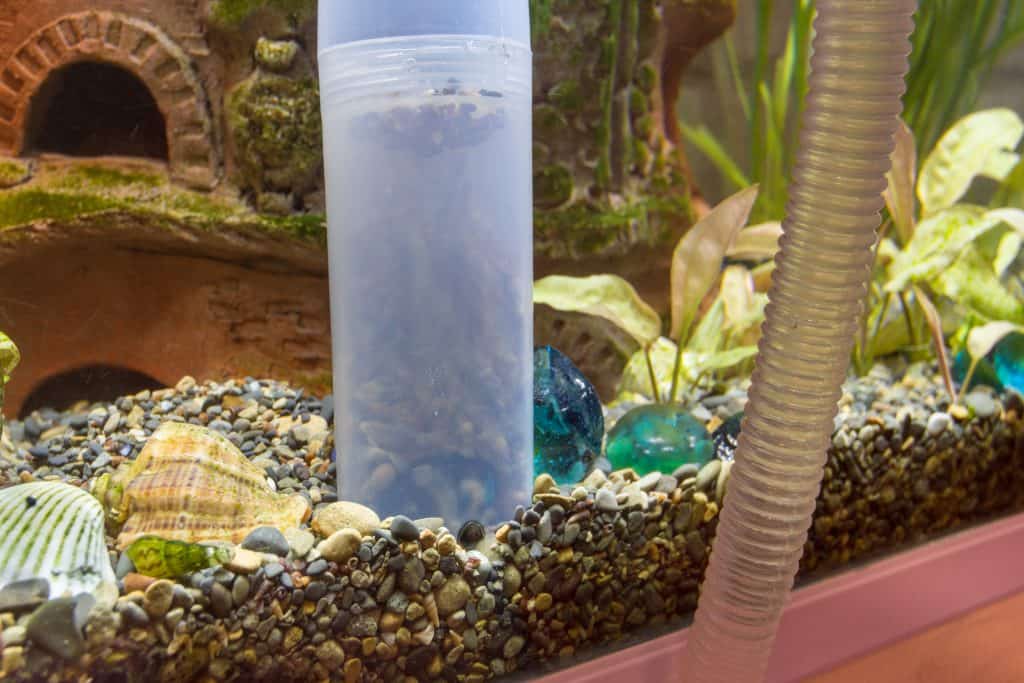
Vacuum approximately one-third of the substrate. Make sure to shift your decorations and hardscape around because debris tends to collect underneath them.
Step 7: Clean the Filter Media
Filter cleaning is an important stride. Think of your filter similar your trash tin can that collects fish poop and other waste material materials. Trash cans need to be emptied regularly, or they get too full and spill all of that nasty stuff back out into your tank! Or, they clog up and overflow all over your squeamish floors! All-time to avoid both situations.
For hang-on-back (HOB) or canister filters, only remove the filter and wash it in the bucket of recently removed tank water. Do not use soapy water or tap h2o, just your tank h2o. For sponge filters, remove the foam and wring information technology out multiple times in the old tank water bucket. Both soap and chlorine from the tap h2o will kill all your beneficial bacteria, and then rinse off all of that gunk with your tank water.
Step 8: Refill the Water
Time to refill your tank with fresh, make clean h2o. Of import things to annotation nigh calculation new water to your tank. First, you want it to roughly match your aquarium'south current temperature to avert a temperature shock. Secondly, never add together tap water direct into your tank. You lot will e'er need to add together dechlorinator to not shock your inhabitants.
Empty out the bucket of quondam tank water (cracking for plants so information technology doesn't go to waste matter!), and refill it with tap water. Add together your dechlorinator into the saucepan (dose on the bucket's book so y'all get everything correctly proportioned). If you lot're maintaining a planted tank, you tin also add fertilizer. When y'all're ready, slowly add the water back into your tank to minimally disturb the substrate. Y'all're going to boot-up particles, even with the slowest pouring, but don't worry! Things will quickly settle inside an hour or so.
Step ix: Turn on Equipment Again
Time to plough everything back on. If you lot accept a heater, remember to adjust the temperature once all water is added back into your tank.
Pace x: Wipe the Glass Clean
For a crystal-clear finish, wipe down the outside walls of the tank with aquarium-condom glass and acrylic cleaner. This will get rid of your fingerprints and any smudges forth the way. Don't forget to dust the chapeau, light, and aquarium stand.
Step 11: Enjoy Your Clean Tank!
Now that the tank is clean, it's time to enjoy your beautiful aquarium! Don't forget to regularly maintain your equipment and perform water changes moving forward. Cleaning is non a one-and-done functioning.
Fish Tank Cleaning Maintenance
In-between total fish tank cleans, we recommend some routine maintenance tasks to keep everything looking clean and cute.
Daily Tank Maintenance
We might have scared you with the thought of daily fish tank maintenance but in reality, the list of to-do items is curt. These chores just take a few minutes and volition assist you lot maintain your fish tank.
- Observe your tank for a infinitesimal or 2. Are all your fish and inhabitants present? Are they healthy? No injuries?
- One time yous do your roll-count, feed everyone! Depending on your fish species, nosotros typically recommend feeding twice a day. Only feed as much as your fish tin eat in a curt period of three-5 minutes. If whatever food is leftover, try to remove it to avoid it clouding the water.
- Lastly, check the water temperature to make certain your heater (if applicable) is functioning correctly.
Weekly Tank Maintenance
Weekly tank maintenance is pretty light every bit well. We recommend:
- Testing the water using an aquarium test kit. Y'all tin can evaluate your pH, nitrate, nitrite, ammonia, and salinity for saltwater tanks. Use a home kit. They're easy to apply and affordable, and will help you stay up to tank on any water condition issues before they get significant.
- Check all your tank equipment, such as a filter or light, to brand certain they're all functioning correctly. Supercede burnt-out lights and make sure your filter is not flood!
How to Make clean An Aquarium FAQs
How do I clean a fish tank which has eggs in it?
The answer depends on where the eggs are laid. If y'all have a big tank and the eggs are safely laid in the substrate on one cease of the tank, you tin probable safely clean the other side of the tank.
However, if information technology all possible, It is recommended to wait to clean a tank with eggs. Wait until the fry are free swimming and and so y'all can modify the water as usual.
How often should I clean my fish tanks?
Depending on the tank, nosotros recommend a solid cleaning every 2-four weeks. If your tank is heavily stocked or has lots of large fish, it will be on the shorter side of that range.
Can you lot use vinegar to clean a fish tank?
Cleaning your fish tank with vinegar is a cheap and effective fashion to remove algae and h2o stains from your tank glass, ornaments, and plants. To make clean an empty tank using vinegar, apply a solution of ane function tap h2o to one office vinegar. Cascade the solution onto a clean sponge and scrub your problem areas. Information technology'southward best to apply white distilled vinegar.
Why do fish die after cleaning tank?
If yous have recently cleaned your fish tank, merely your fish die soon after, in that location is a high take a chance something in your water parameters, such equally ammonia levels, went awry. This ammonia toxicity can kill them quickly. When a sudden, big water alter occurs, it causes a major shift in water parameters that the fish struggle to accommodate to quickly, causing their sudden demise.
Should you change water later on fish died?
Starting time, remove the dead fish from your water promptly. A dead corpse in y'all water volition decompose and release potential bacteria and disease into the water, jeopardizing the wellness of your other fish. Secondly, examination your h2o to check out the water parameters to see if you're having any issues that could be the cause of death and/or require a water alter. More often than not, we do recommend doing a fractional water change later on a fish death in order to keep everything clean and functional.
How to Make clean an Aquarium – Conclusion
Caring for your aquarium is a lot of work but it doesn't have to be daunting. Learning how to make clean an aquarium is an important part of responsible pet ownership. If yous follow the steps outlined in this guide, y'all will non only go along your fish happy and healthy, you'll likewise enjoy an aesthetically pleasing addition to your living space!
The best role virtually owning a clean aquarium? You lot tin meet all the beautiful fish and aquatic critters on brandish with no worries that they are existence smothered by algae or waste matter.
What'south been your feel cleaning your aquarium? We want to hear from you so we can learn more about what works and what needs improvement!

Source: https://www.aquariumfriend.com/how-to-clean-an-aquarium/
Posted by: dixonbeepon.blogspot.com
0 Response to "Is Vinegar Safe To Clean Fish Tank"
Post a Comment